Begin with the layers
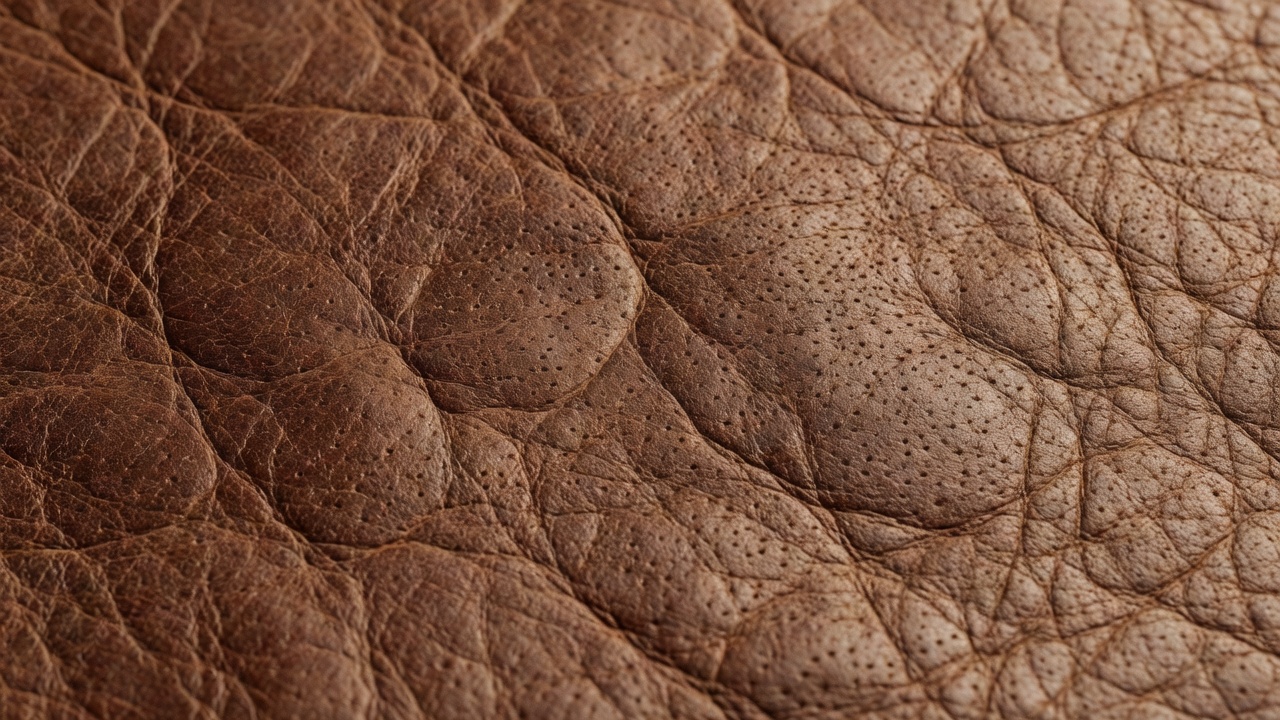
A hide is not uniform from one face to the other, nor from one anatomical area to another. Its outer grain layer differs from the more open fibrous material beneath. Splitting separates a hide into layers; shaving and other preparation help establish a usable thickness. The leather selected for a supple pocket may therefore differ from the leather chosen for a handle, even within one bag.
Full-grain leather retains the grain surface without corrective removal by buffing. That description does not tell you the species, thickness, tanning recipe, finish durability or quality of the cutting. “Top grain” is used less consistently in consumer marketing and needs clarification. Ask whether the grain has been corrected and what surface coating has been applied. A precise answer is more useful than a ladder of supposed universal grades.
Split leather comes from a layer below the grain. It can be useful for particular applications, but a heavily coated split should not be mistaken for an intact grain structure. “Genuine leather” alone is not a performance specification. Read it as an invitation to ask more questions, rather than as either a promise of excellence or proof of poor quality.
Tanning is not a quality ranking
Tanning makes hide resistant to putrefaction and creates a stable material. Vegetable tanning uses plant-derived tannins; chrome tanning uses chromium salts, typically chromium(III). Combination processes also exist. These categories influence how a leather can be made, but they do not determine one inevitable feel, colour or service life.
A firm vegetable-tanned strap and a soft chrome-tanned body panel may both be appropriate engineering choices. Thickness, lubrication, retanning and finishing alter the result. Nor does “vegetable” automatically mean a lower environmental impact in every comparison. Water, energy, chemical management, processing yield and the boundaries of an assessment all matter.
For travel goods, start with the task. A fold needs flexibility without excessive bulk. A handle needs an appropriate balance of comfort, shape retention and reinforcement. An unsupported large panel must resist unwanted stretching. Selecting the same leather everywhere can be visually coherent while being mechanically unhelpful.
Understand the surface treatment
Aniline descriptions generally indicate a transparent colouring approach that leaves natural character visible. Semi-aniline finishes add some protection while preserving aspects of that appearance. Pigmented finishes offer more coverage and consistency. Exact formulations vary, so ask the maker how the particular material responds to water, rubbing and cleaning.
| Description | What to investigate | Travel implication |
|---|---|---|
| Full grain | Finish, thickness and cutting selection | Natural character does not remove the need for protection. |
| Corrected grain | Extent of correction and coating flexibility | Uniform appearance can be useful; inspect repeated folds. |
| Aniline finish | Supplier-specific water and rub resistance | More visible change may need to be accepted. |
| Pigmented finish | Coating adhesion and care instructions | Surface protection still has limits at abrasion points. |
| Split leather | Coating, backing and intended application | Construction and placement deserve particular attention. |
Do not scratch a shop sample or apply water without permission. Gently flex an approved sample and look for an even response rather than abrupt coating separation. Smell is not a reliable test of tanning chemistry or authenticity. Fragrance, packaging and finishing products can all influence it.
Ask for traceability with boundaries
A country-of-manufacture statement describes a legal origin claim for the finished item; it does not necessarily identify where the animal was raised or the hide was tanned. A tannery name gives a more specific lead, but it still is not a complete supply-chain account. Ask which stage a claim covers and whether documentation applies to the actual material in the product.
Leather Working Group audits assess leather manufacturers against defined protocols. They are not an automatic durability certificate for a finished bag. Similarly, a reference to REACH concerns a regulatory framework rather than a blanket declaration that every possible environmental or ethical issue has been resolved. The European Chemicals Agency provides the relevant regulatory context.
Known tanneries such as Horween in Chicago and J & FJ Baker in Colyton illustrate different traditions and specialisms, not a universal ranking of finished goods. For exotic species, consult CITES requirements before purchasing or crossing borders. When information is missing, record the uncertainty instead of filling it with a reassuring story.