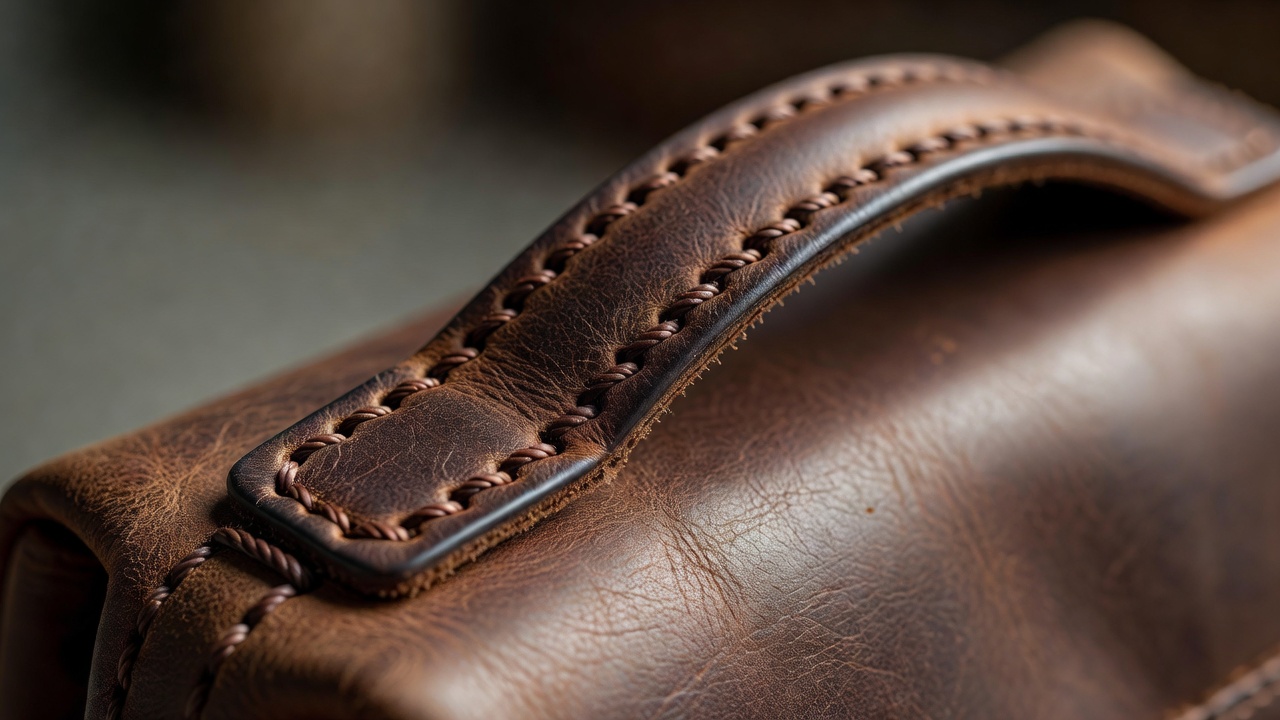
Draw a route from contents to grip
Imagine a loaded weekender lifted from the floor. Its contents press against the base, the base joins the side panels, and the side panels connect to handle or strap attachments. At each junction, force changes direction or spreads into a different area. A broad leather panel may cope comfortably while a small attachment concentrates stress into a much narrower region.
Look at where the handle ends. A tab stitched directly onto a thin outer panel is not equivalent to a tab supported by an internal patch or webbing system. The supporting material need not be visible, so ask the maker how the attachment is backed. A lining can conceal thoughtful reinforcement just as easily as it conceals its absence.
This is a method of observation, not a home strength test. Do not pull sharply on display goods or exceed a manufacturer's stated load. Even a convincing construction diagram cannot establish a safe carrying capacity without appropriate testing. SATRA's luggage and leather-goods services illustrate why laboratory evaluation considers components and whole products separately.
Read the stitch as a system
A common machine lockstitch interlocks needle and bobbin threads within the material assembly. Traditional hand saddle stitching typically uses two needles on opposite ends of a thread, passing through prepared holes. These are different systems with different production and repair characteristics. Neither label, on its own, proves that the finished seam suits its job.
Thread size, needle or awl size, stitch spacing, tension and distance from the edge work together. If holes are excessively large or closely spaced for a particular leather, they can weaken the material between them. If a seam sits too near an unsupported edge, it may tear out before the thread itself fails. Very fine stitching can be elegant without being appropriate for a heavily loaded junction.
Check for skipped stitches, loose loops, abrupt changes in tension and damaged leather around holes. A slight visual irregularity in hand work is not necessarily a structural defect; a mechanically even seam can still have poor material support. Ask what thread is used and why. Coats and Gütermann publish information on threads for leather applications, including considerations such as abrasion and processing.
Understand thickness transitions
Skiving reduces leather thickness locally. Makers use it to keep folded edges, seams and overlapping parts from becoming bulky. Done appropriately, it allows a clean transition between layers and helps a fold sit without fighting itself. Excessive reduction at a load-bearing point, however, may leave too little material to support the intended stress.
A turned seam encloses its cut edges; a bound seam covers them with another strip; an exposed edge can be painted, burnished or otherwise finished. These are construction choices rather than universal quality levels. Consider abrasion, flexibility and future access. A neat enclosed seam may be harder to repair if reaching it requires substantial disassembly.
Adhesive often helps position layers before stitching and can contribute to the assembly's behaviour. Its presence does not make a sewn product fraudulent or inferior. The important questions are whether the bond suits the materials, whether the stitching does the intended work, and whether flexing or heat will expose a weakness. Surface neatness alone cannot answer them.
Distinguish reinforcement from decoration
Rivets can secure layers, but their performance depends on material, post length, setting and the strength of the surrounding assembly. A shiny rivet placed through thin unsupported leather can still tear free. A washer or backing plate may distribute pressure, although it needs enough space and suitable edges to avoid creating another wear point.
A box-and-cross stitch pattern is often seen on webbing attachments because it places stitching across a useful area. It is not a magic symbol. The webbing, seam dimensions, thread and supporting panel must all suit the load. Likewise, adding more stitch rows does not automatically improve a small leather tab if it creates excessive perforation.
- Follow the handle attachment beyond its visible surface.
- Inspect corners and thickness changes for strain or distortion.
- Ask whether straps, tabs and reinforcement can be replaced.
- Request a stated load limit rather than estimating one by touch.
End your inspection at the base. Feet can lift leather from a clean flat surface, but they do not waterproof the bag and may transfer load into small points. Base reinforcement should support the intended contents without making the empty bag unnecessarily heavy. The goal is a coherent route for force, not the greatest possible number of components.